
Get booked when clients ask where to go.
Clients ask assistants which salon is good with curly hair, who does balayage nearby and which spa is worth a gift card. Speak Local shows which salons and spas get named, and checks the service pages, profile and reviews the answers draw on.
Free, in under a minute, no email or card. It grades up to 25 pages across Local, SEO, AEO and GEO.
How does a salon or spa get recommended in Google Maps and AI answers?
By naming what you do and who does it, in text machines can read: each service with a price range and how long it takes, your stylists and their specialties, your hours and a booking link, the same on your website and your Google Business Profile. Reviews that name the service and the stylist do the rest, because assistants summarize them when someone asks where to book. Mark the business up as a HairSalon, NailSalon, DaySpa or BeautySalon.
Updated 19 October 2026
What do clients ask before they book?
Clients ask about specialties, prices and who can fit them in. These six are worth tracking:
- Best hair salon near me for curly hair
- Where can I get balayage in your city?
- How much does a gel manicure cost in your city?
- Barber near me that takes walk-ins
- Best day spa in your city for a couples massage
- Who does bridal hair in your area?
These are examples to adapt. Put the ones that bring you business to ChatGPT, Perplexity and Gemini on a weekly or monthly round, and each answer is recorded as named, cited or absent, with whoever was named in your place. How AI answers are tracked
What do Google and AI assistants weigh for a salon or spa?
Clients choose a person as much as a place, and the most useful answers name both.
A page for each service you want booked
Balayage, men’s cuts, gel nails and facials are different searches from different clients. A single services menu gives none of them a page to rank. Give each its own page: what it involves, a price range, how long it takes and who does it.
Stylists with names and specialties
Clients ask for someone good with curls, color correction or fades. A page for each stylist, with what they specialize in and how to book them, gives an assistant a person to recommend as well as a salon.
Booking in one step
A booking link on your profile and on every service page, into the same system your front desk uses. A client who finds you at 10pm should be able to book at 10pm.
Reviews that name the service and the stylist
“Maya fixed my box-dye disaster in one visit” tells an assistant what you do, who does it and how well. Ask every client after every appointment, the same way. Google’s policy says not to suggest wording, not to ask only happy clients and not to offer anything in return.
Which schema should a salon or spa use?
HairSalon, NailSalon, DaySpa and BeautySalon are all schema.org health and beauty businesses. There is no barbershop type, so a barber uses HairSalon. A salon with a spa can describe the spa as a department with its own hours.
List your services in an hasOfferCatalog, and each stylist as a Person under employee, with their specialties in knowsAbout. Speak Local’s scanner reads each of these types as entity schema on your homepage.
Worth checking: that your late nights and closed days in your schema match your Google listing. A client looking for an evening appointment trusts the hours an assistant repeats.
hasOfferCatalogwith each service you want bookedemployeefor each stylist, withknowsAboutopeningHoursSpecification, late nights includedsameAsfor your booking and review profiles
Check it with Google’s Rich Results Test or the Schema Markup Validator before it goes live.
{
  "@context": "https://schema.org",
  "@type": "HairSalon",
  "@id": "https://www.example.com/#salon",
  "name": "Example Salon & Spa",
  "url": "https://www.example.com/",
  "telephone": "+1-555-0100",
  "address": {
    "@type": "PostalAddress",
    "streetAddress": "100 Example Street",
    "addressLocality": "Your City",
    "addressRegion": "ST",
    "postalCode": "00000",
    "addressCountry": "US"
  },
  "openingHoursSpecification": [
    {
      "@type": "OpeningHoursSpecification",
      "dayOfWeek": ["Tuesday", "Wednesday", "Saturday"],
      "opens": "09:00",
      "closes": "18:00"
    },
    {
      "@type": "OpeningHoursSpecification",
      "dayOfWeek": ["Thursday", "Friday"],
      "opens": "09:00",
      "closes": "20:00"
    }
  ],
  "hasOfferCatalog": {
    "@type": "OfferCatalog",
    "name": "Services",
    "itemListElement": [
      {
        "@type": "Offer",
        "itemOffered": {"@type": "Service", "name": "Balayage"}
      },
      {
        "@type": "Offer",
        "itemOffered": {"@type": "Service", "name": "Haircut"}
      }
    ]
  },
  "employee": [
    {
      "@type": "Person",
      "name": "Jordan Example",
      "jobTitle": "Senior Stylist",
      "knowsAbout": ["Balayage", "Curly hair"]
    }
  ],
  "department": [
    {
      "@type": "DaySpa",
      "name": "Example Spa",
      "telephone": "+1-555-0101"
    }
  ]
}
Where should a salon or spa start?
Do these in order. The first and the fourth cost nothing.
-
Make your Google profile match the salon
The right primary category, each service with a price, your late nights, a booking link and recent photos of real work.
-
A page for each service you want booked
Color, cuts, nails, facials: what each involves, a price range, how long it takes and who does it.
-
A page for each stylist
Their specialties, the services they do and a link to book them.
-
Ask for a review after every appointment
The same way for every client, with no wording suggested and nothing offered in return.
-
Track the questions clients ask
Specialty, price and same-day questions on ChatGPT, Perplexity and Gemini, against the salons that already get named.
How does Speak Local help a salon or spa?
Every plan includes all of it. See the full platform for how the pillars combine into one score.
What it looks like for a salon or spa
Six screens from the workspace of an example hair salon and day spa, as they look in the app. Choose one to see it.
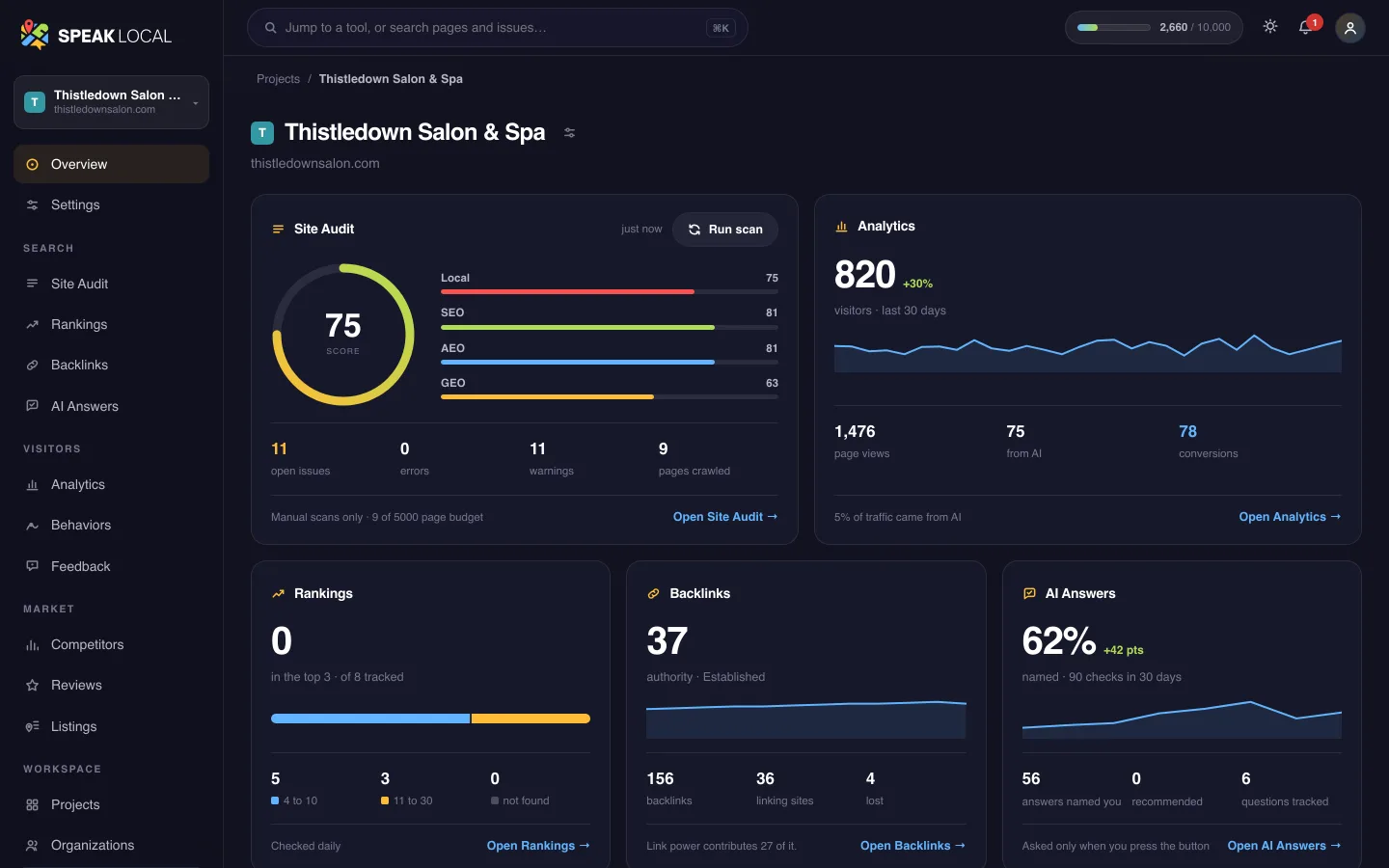
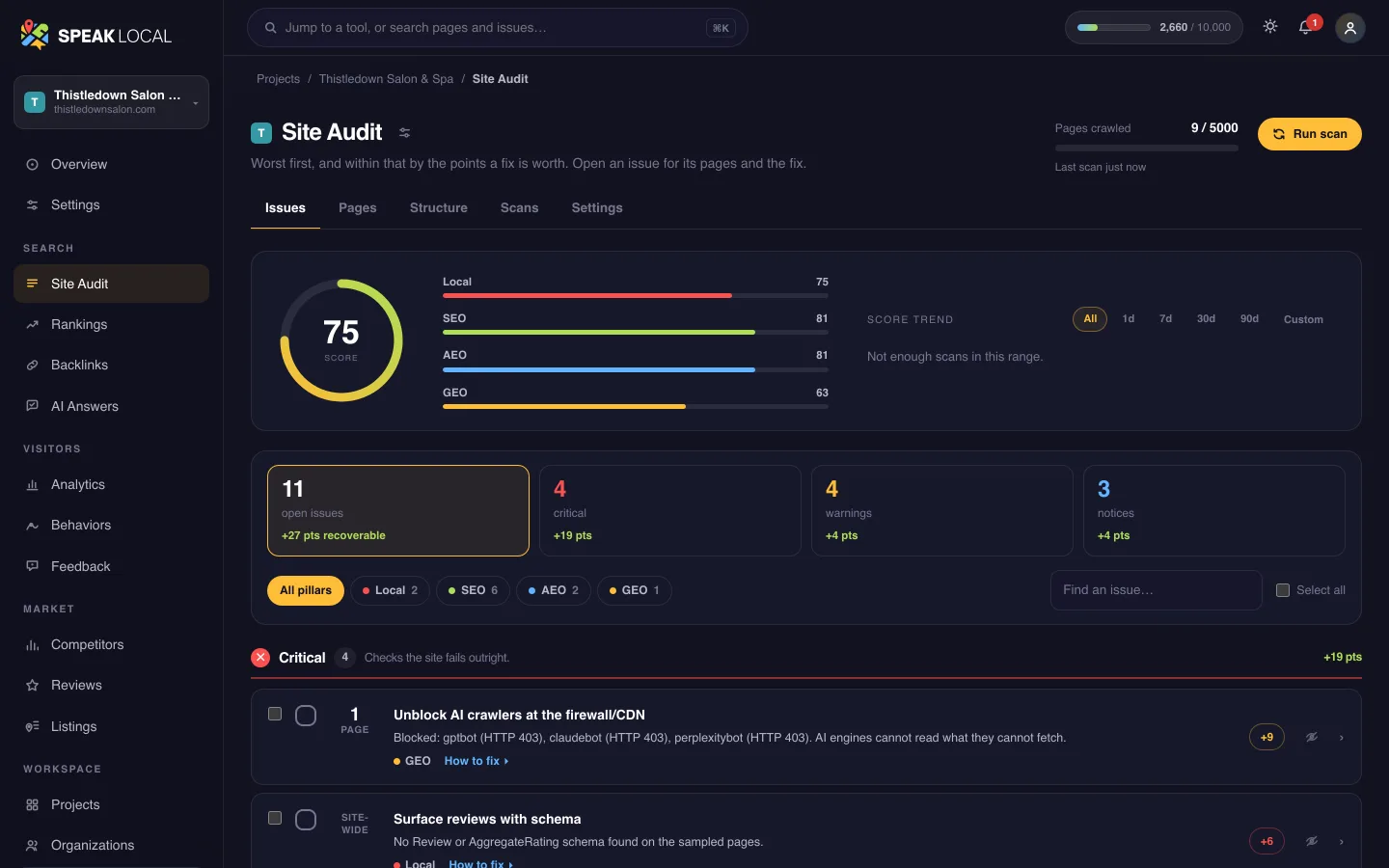
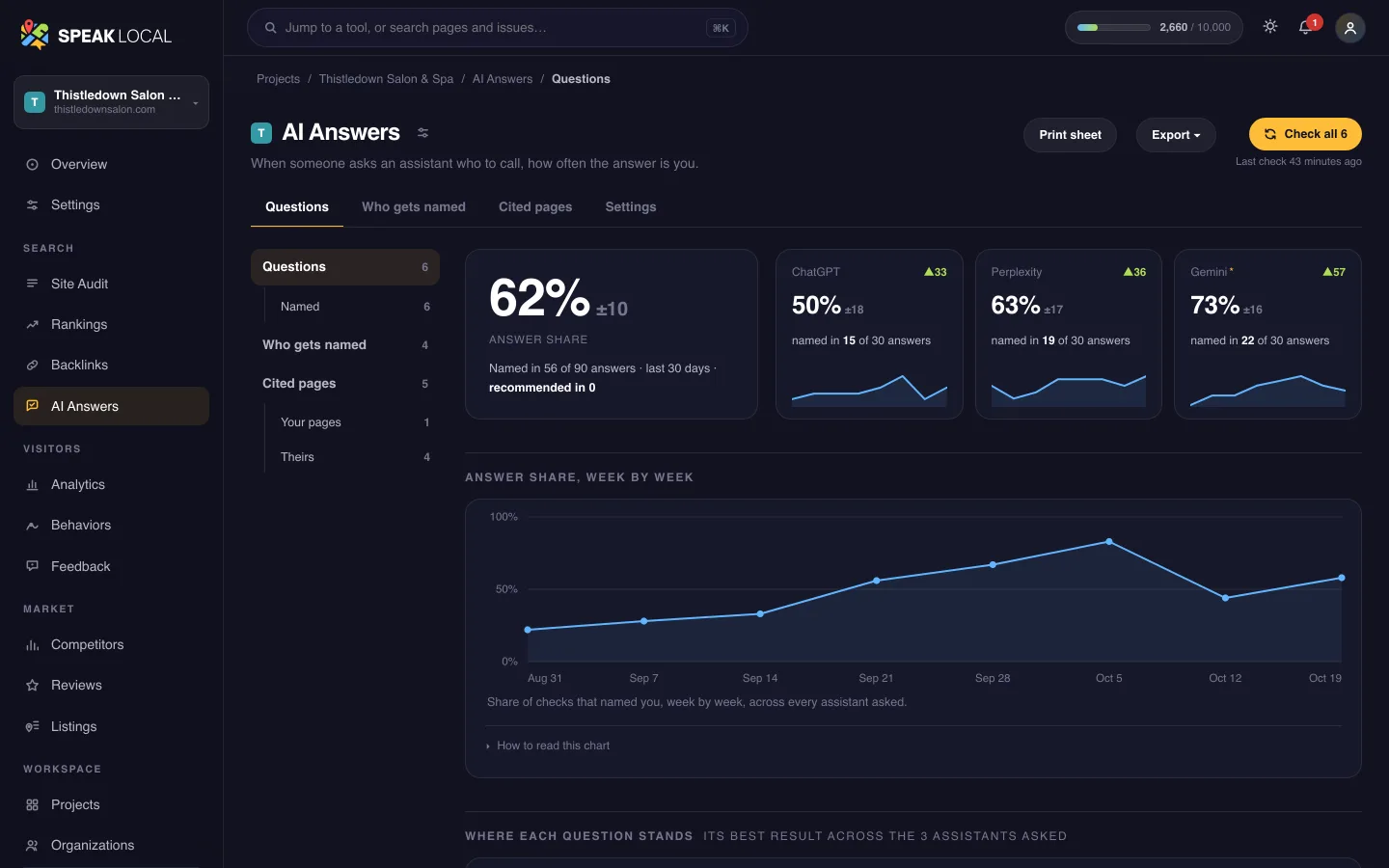
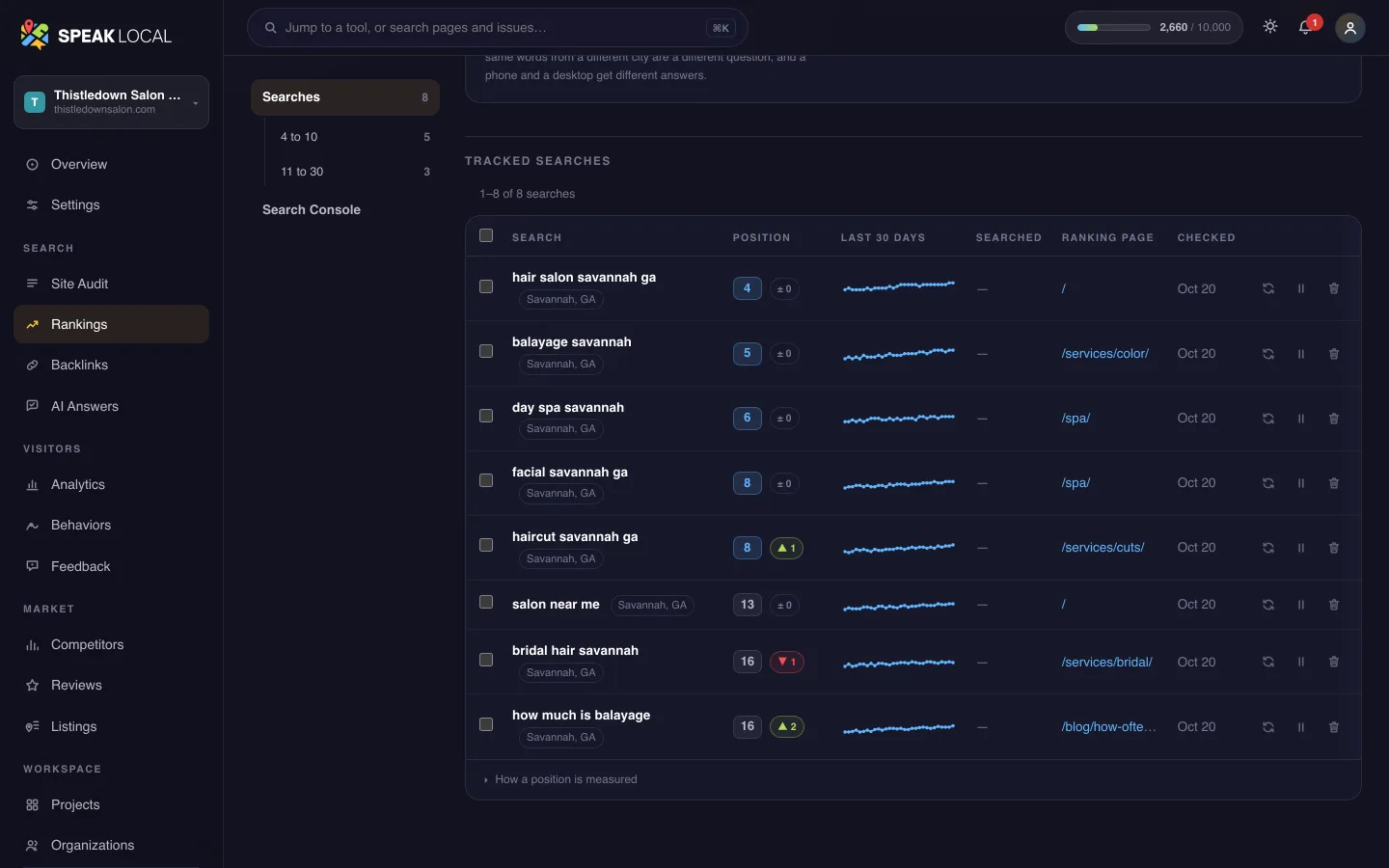
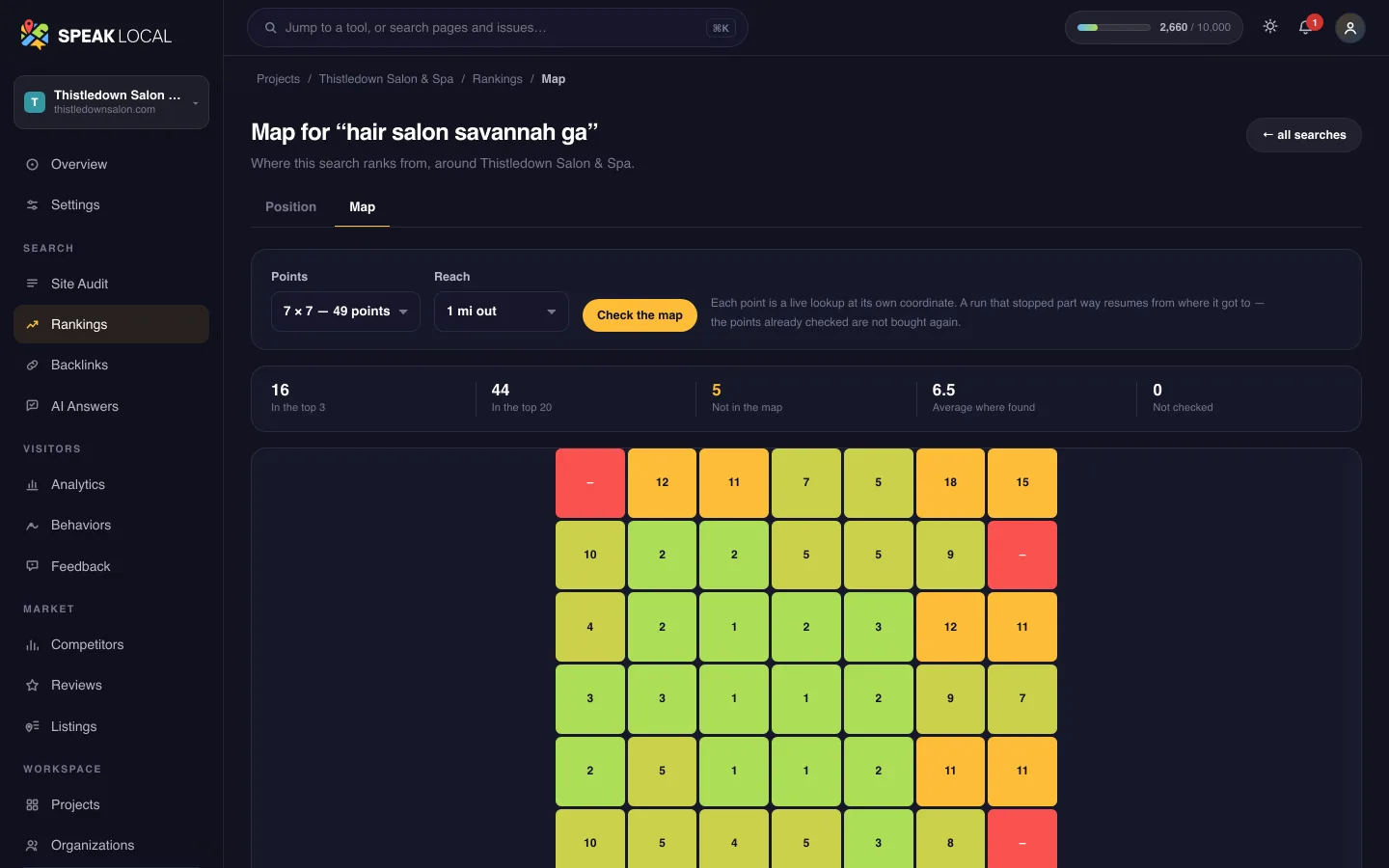
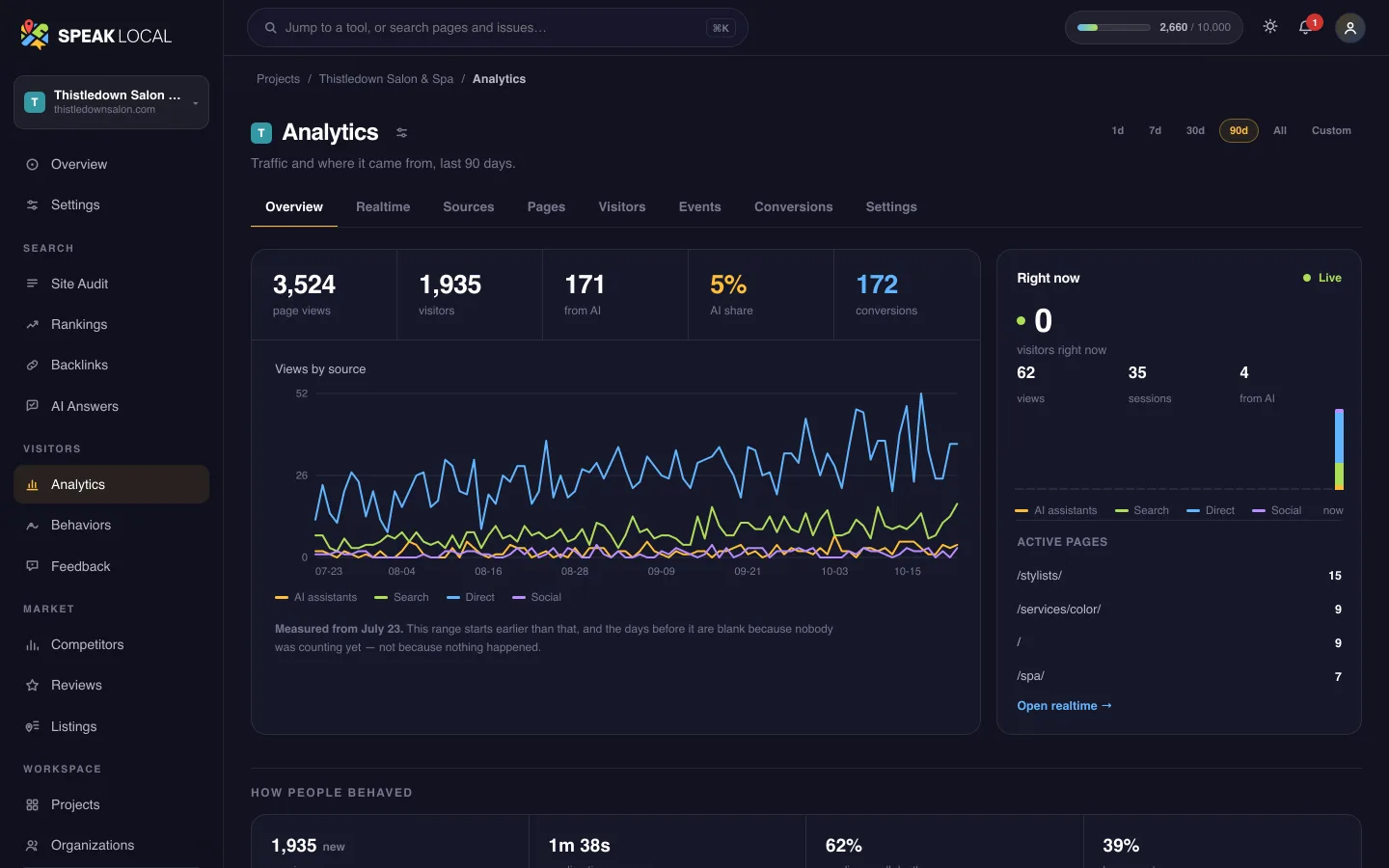
An example workspace for a fictional hair salon and day spa. The site audit and the competitors’ scores are real scans of test sites; the rankings, answers and traffic are sample data. Swipe the screen to see all of it.
Common questions
Can each stylist have their own Google listing?
Should we publish prices?
We take bookings through an app. Does that count as our website?
Does Speak Local work for barbers, nail salons and spas?
Can a salon with several locations track them all?
See where a salon or spa like yours stands.
Audit, score, fix and monitor how you show up in Google and in AI answers.
Free, in under a minute. No account. Or start a plan from $49/mo