
Be the firm people trust with their money.
People ask assistants which CPA is good with small businesses, who can help with an IRS letter and which agent writes home and auto together. Speak Local shows which firms get named, and checks the credentials, pages and listings the answers draw on.
Free, in under a minute, no email or card. It grades up to 25 pages across Local, SEO, AEO and GEO.
How does an accounting, financial or insurance firm get recommended in Google Maps and AI answers?
By making trust easy to check. Google gives extra weight to trust on topics that affect people’s finances, so put named people on your pages with their credentials (CPA, EA, CFP or an insurance license) and a link to where each can be verified, answer the questions clients ask in plain language with a byline and a date, and keep your services, fees and seasonal hours the same on your site and your Google Business Profile. Mark the firm up as an AccountingService, InsuranceAgency or FinancialService, with hasCredential on each person.
Updated 19 October 2026
What do clients ask before they choose a firm?
Clients ask about credentials, fees and who can help right now. These six are worth tracking:
- CPA near me who works with small businesses
- How much does a tax preparer charge in your city?
- I got a letter from the IRS. Who can help in your city?
- Best independent insurance agent in your city
- Fee-only financial advisor near me
- Do I need a CPA or is a tax preparer enough?
These are examples to adapt. Put the ones that bring you business to ChatGPT, Perplexity and Gemini on a weekly or monthly round, and each answer is recorded as named, cited or absent, with whoever was named in your place. How AI answers are tracked
What do Google and AI assistants weigh for a financial or insurance firm?
Google says it gives extra weight to trust on topics that can affect people’s finances, and a client choosing who handles their money does the same.
Credentials anyone can check
Name each person’s credentials, such as CPA, enrolled agent, CFP or a state insurance license, and link to where they can be verified: CPAverify, the IRS directory of credentialed preparers, FINRA BrokerCheck, the SEC’s adviser search or your state’s license lookup. A checkable license says more than “trusted advisors” does.
A person behind every answer
Google’s guidance asks whether a page carries a byline that leads to the author’s background. A tax or insurance page signed by a named CPA or agent, with a bio and the date it was last checked, gives an engine a reason to trust it.
Plain answers to money questions
“Do I need a CPA or is a tax preparer enough?” and “What does umbrella insurance cover?” are the questions clients put to assistants. A page that answers each in its first two sentences, then explains, gives them something accurate to repeat. Keep figures current: last year’s limits are this year’s wrong answers.
Reviews inside your rules
Accountants and insurance agents can ask every client the same way, with nothing offered in return. Registered investment advisers work under the SEC’s Marketing Rule, which requires disclosures, such as whether the person is a current client, when testimonials appear in their advertising. Ask your compliance team before requesting or sharing reviews.
Which schema should a financial or insurance firm use?
AccountingService for accountants and tax preparers, InsuranceAgency for agencies and FinancialService for advisers and planners, all schema.org financial businesses. A bank or credit union has its own type, BankOrCreditUnion.
Mark each person up as a Person with hasCredential for the license or designation. Speak Local’s scanner reads each of these business types as entity schema on your homepage, and checks whether your pages name real people.
Worth checking: that your tax-season or open-enrollment hours are in your Google profile as special hours, and that your site and schema say the same. Extended hours are a detail clients check before they call.
hasCredentialon each person: CPA, EA, CFP or a licenseopeningHoursSpecificationwithvalidFromandvalidThroughfor seasonal hoursareaServedfor the places you’re licensed to worksameAsfor your firm’s profiles on review sites
Check it with Google’s Rich Results Test or the Schema Markup Validator before it goes live.
{
  "@context": "https://schema.org",
  "@type": "AccountingService",
  "@id": "https://www.example.com/#firm",
  "name": "Example Tax & Accounting",
  "url": "https://www.example.com/",
  "telephone": "+1-555-0100",
  "address": {
    "@type": "PostalAddress",
    "streetAddress": "100 Example Street",
    "addressLocality": "Your City",
    "addressRegion": "ST",
    "postalCode": "00000",
    "addressCountry": "US"
  },
  "openingHoursSpecification": [
    {
      "@type": "OpeningHoursSpecification",
      "dayOfWeek": [
        "Monday", "Tuesday", "Wednesday", "Thursday", "Friday"
      ],
      "opens": "08:00",
      "closes": "17:00"
    },
    {
      "@type": "OpeningHoursSpecification",
      "dayOfWeek": "Saturday",
      "opens": "09:00",
      "closes": "13:00",
      "validFrom": "2027-01-15",
      "validThrough": "2027-04-15"
    }
  ],
  "employee": [
    {
      "@type": "Person",
      "name": "Alex Example",
      "jobTitle": "Certified Public Accountant",
      "url": "https://www.example.com/team/alex-example",
      "hasCredential": {
        "@type": "EducationalOccupationalCredential",
        "credentialCategory": "license",
        "name": "Certified Public Accountant"
      }
    }
  ]
}
Where should a financial or insurance firm start?
Do these in order. If a compliance team signs off your marketing, show them the fourth first.
-
Put every person’s credentials on the site
A bio for each CPA, agent or adviser, with the designation, a license number where your rules allow it, and a link to the public lookup.
-
Set your profile up for the season
The right primary category, the services you offer, and special hours for tax season or open enrollment.
-
Answer clients’ questions, signed
A page for each service and each common question, with a byline, a date and figures that are current.
-
Ask for reviews within your rules
The same way for every client, with nothing offered in return, and with your compliance team’s sign-off if you’re an adviser.
-
Track the questions on a schedule
Weekly in your busy season and monthly the rest of the year, on ChatGPT, Perplexity and Gemini, against the firms that already get named.
How does Speak Local help a financial or insurance firm?
Every plan includes all of it. See the full platform for how the pillars combine into one score.
What it looks like for a financial or insurance firm
Six screens from the workspace of an example tax and accounting firm, as they look in the app. Choose one to see it.
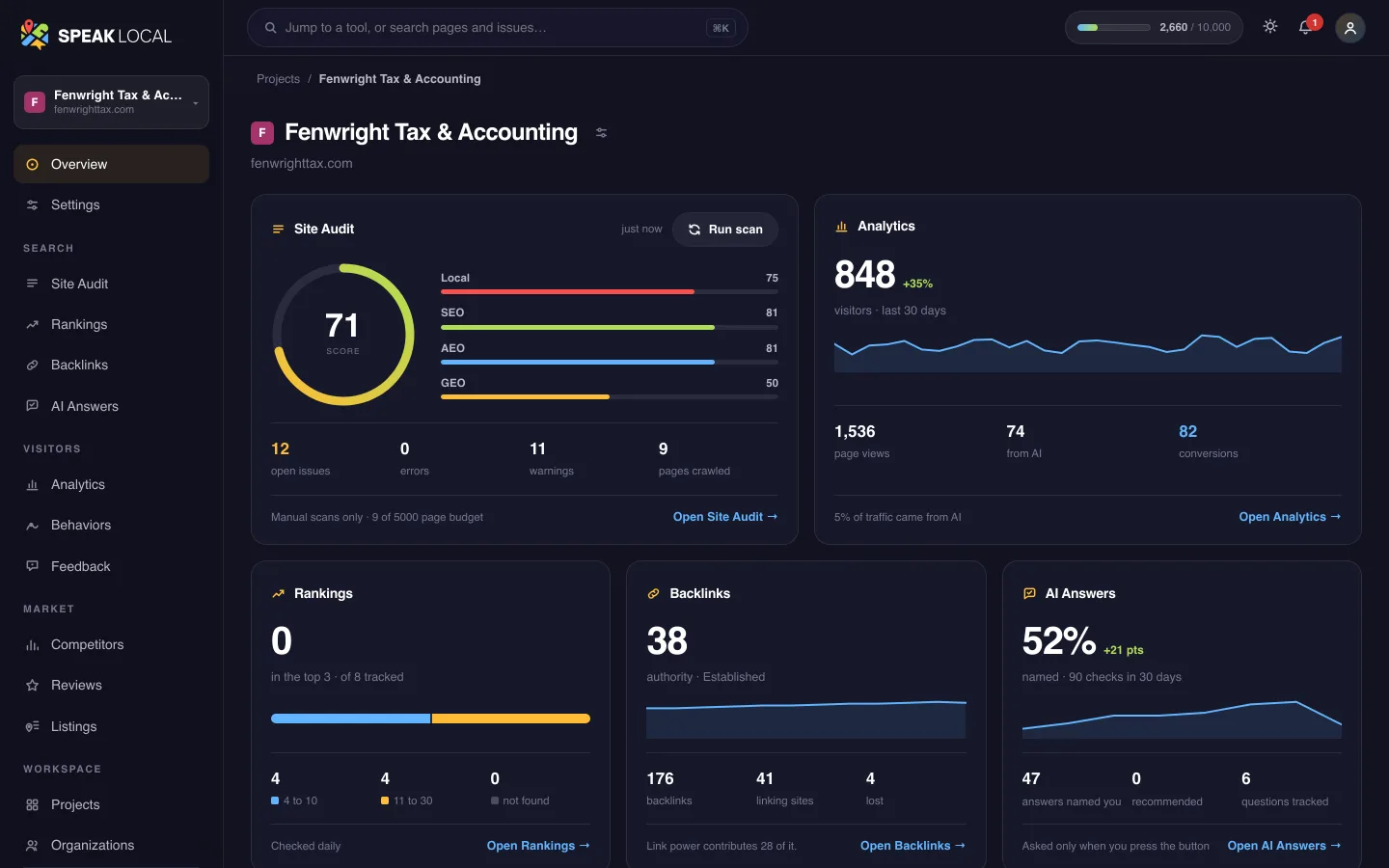
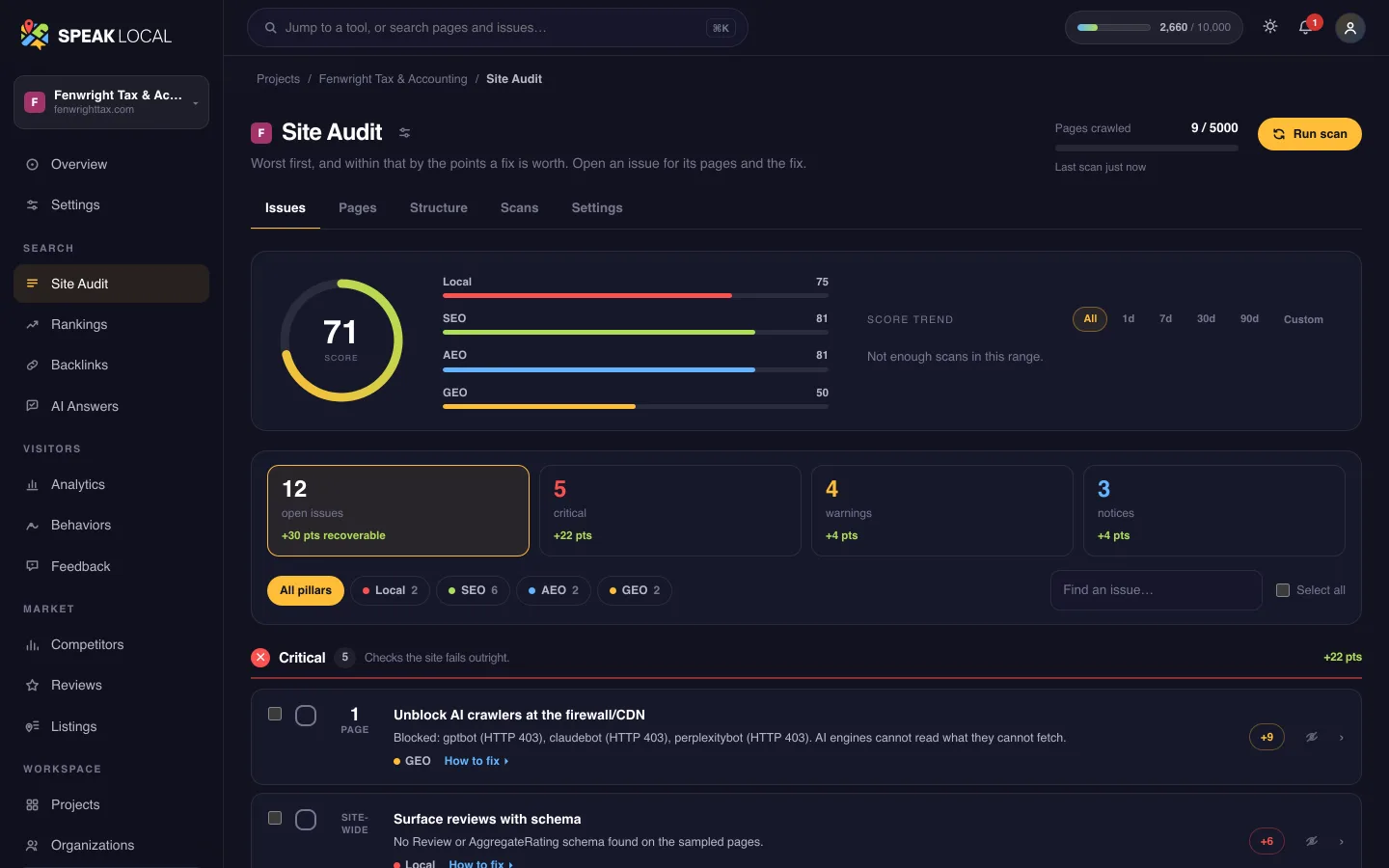
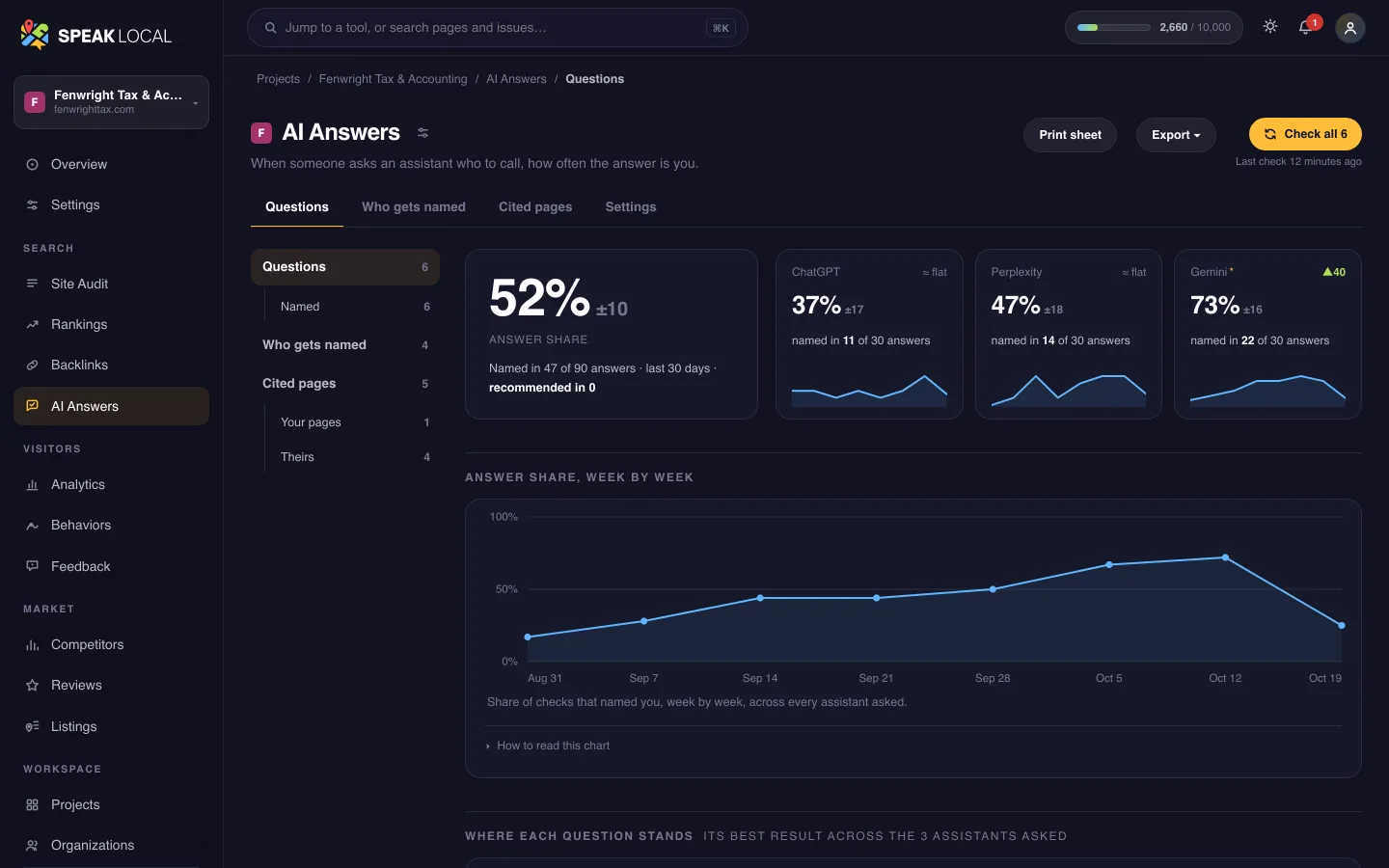
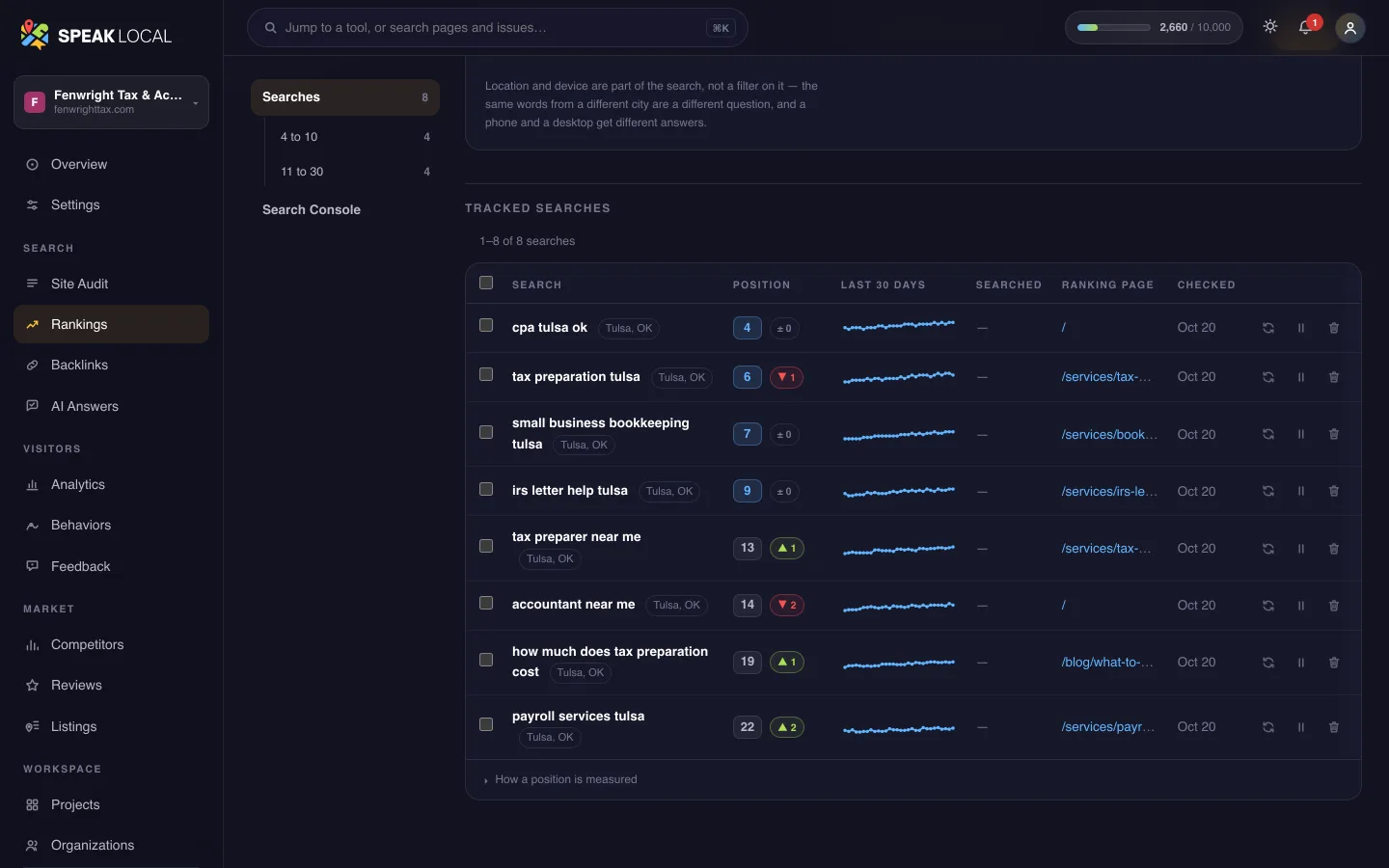
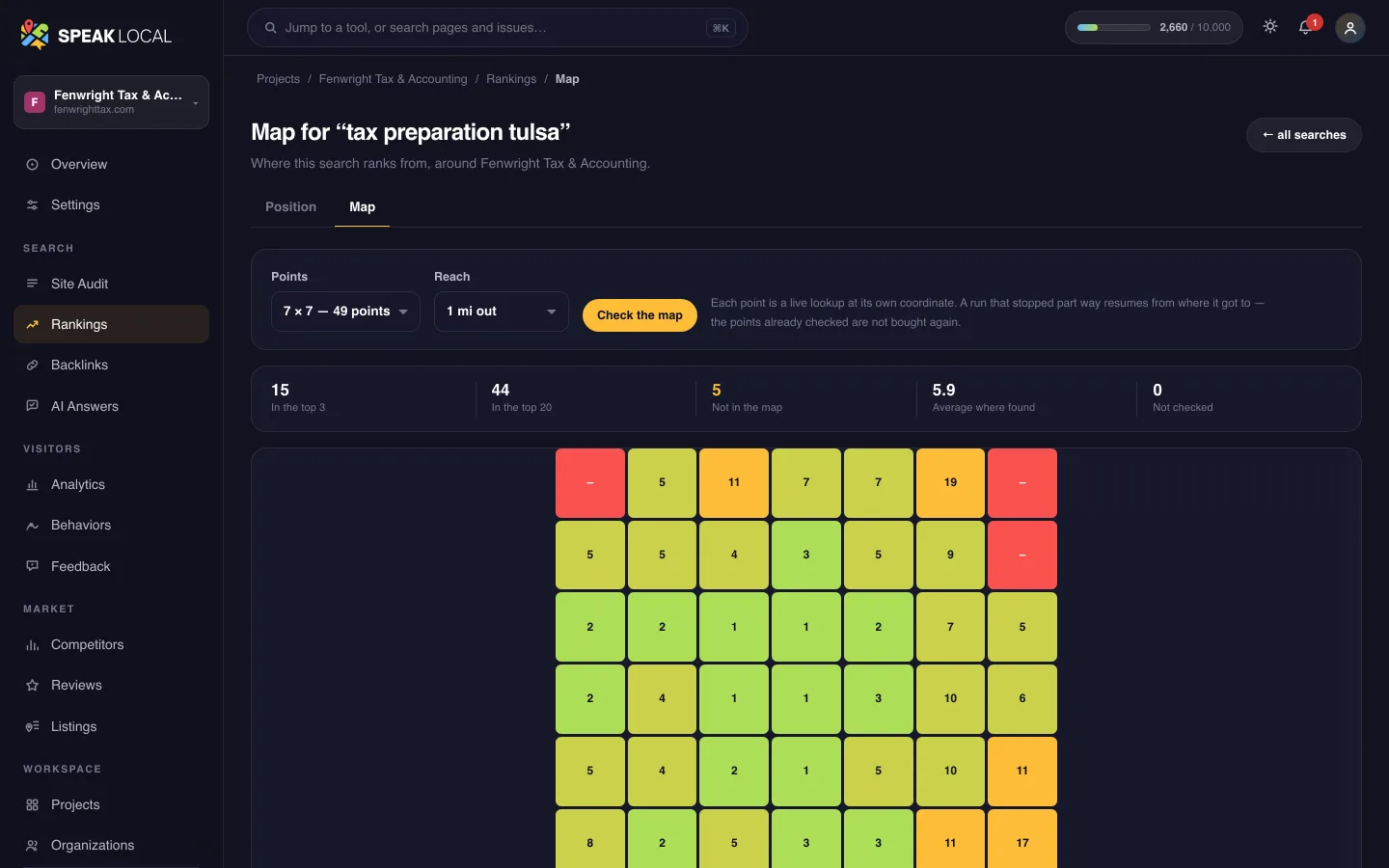
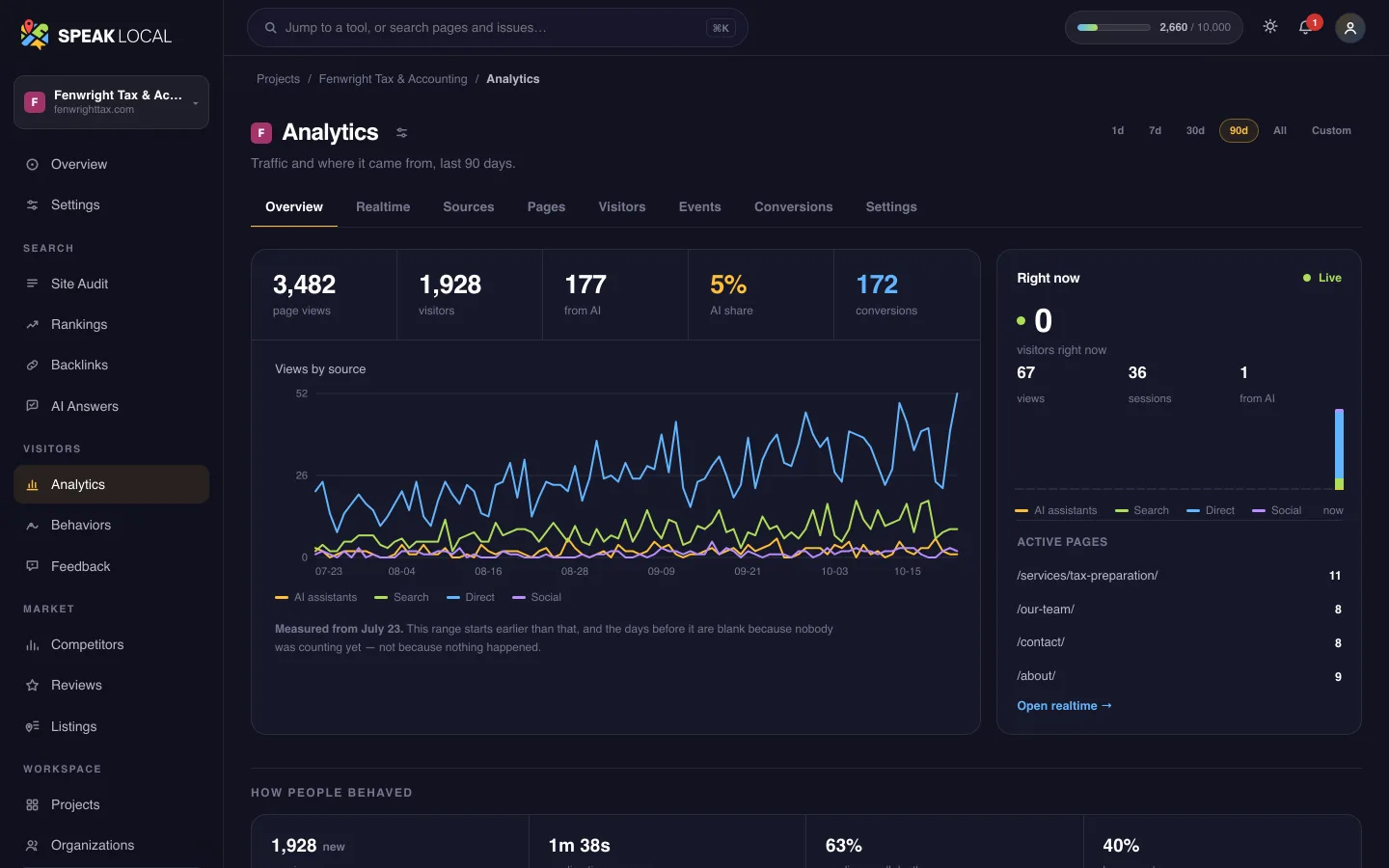
An example workspace for a fictional tax and accounting firm. The site audit and the competitors’ scores are real scans of test sites; the rankings, answers and traffic are sample data. Swipe the screen to see all of it.
Common questions
Can a financial adviser ask clients for Google reviews?
Should we publish our fees?
Does tax season change what we should track?
Does Speak Local work for banks, credit unions and insurance agencies?
Can a firm with several offices track them all?
See where a financial or insurance firm like yours stands.
Audit, score, fix and monitor how you show up in Google and in AI answers.
Free, in under a minute. No account. Or start a plan from $49/mo